This year marks Gallery Aferro's 20th anniversary as an art institution pushing the boundaries of what's possible in the Newark, NJ art world, and they celebrated with their annual benefit auction party. This year also marks the 10th anniversary since I first exhibited there. A decade ago, fresh out of graduate school, they afforded me the opportunity to create my very first public art installation, a collaboration with Marc D'Agusto called Venae Cavae (I blogged extensively about that experience here). This was a seminal piece for me, really pushing me to expand my skills in computer vision and push the boundaries of what I thought possible for public art. Much credit goes to Marc for his collaborative vision and networking.
Since that time, Aferro has shown so much support to me, affording opportunities for experimentation, and I've tried to reciprocate. I had the good fortune to contribute work to 3 of their art auctions, joined with Oculus Art Collaborative to create an experimental, interactive sound installation for Object Oriented Ontological Action (O.O.O.A)that had a follow-up exhibition in Brooklyn (which where among the most fun I've ever had in an exhibition, to be honest), and they consulted with me for the creation of their interactive payphone installation and commissioned me to create the infrastructure for their ongoing sound art installation Elevator Music. If you've ever enjoyed music inside their defunct antique elevator, I designed the programmable, motion activated system for presenting their rotation of curated sound art, which is still going strong today, 6 years later.
The PIR motion sensor I rigged up for Elevator Music, still in place
Generally for these auctions I've contributed existing drawings I had in my collection, but I really felt like this landmark anniversary deserved a piece created specifically for the occasion.
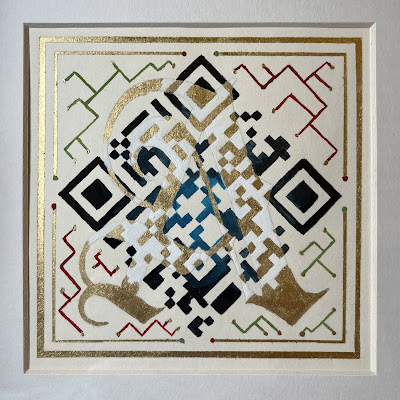
Illuminated Meditations
My initial impulse was to contribute something that fits within my longstanding Meditations series of QR code mandalas, but I also really wanted to continue exploring my more recent foray into illuminated manuscripts. So I figured why not combine them!
So I decided to create a QR code mandala that would incorporate an illuminated initial "A" (for Aferro, of course). The beauty of this would be the versatility of the A as the "alpha," the genesis of language in general, and a suitable generic variable for all its multiplicities meanings. At first the QR code, when scanned, would lead to Aferro's website, particularly the page advertising the auction itself. However, by utilizing the custom coded short-link system I developed, I would be able to change the destination of the QR code to any destination the gallery or purchaser desired, even after having drawn the completed code.
Inspired by the drop caps in my illuminated manuscript, I followed similar design motifs...
And because of the reflectivity of the gold leaf, at some angles the QR code comes to the foreground and becomes scannable...
while at other angles the initial comes to the foreground and the code becomes unscannable. This was an intentional effect to promote another layer of interactivity, drawing awareness to the viewer's own bodily position in relation to the piece as they view it.
Bloom
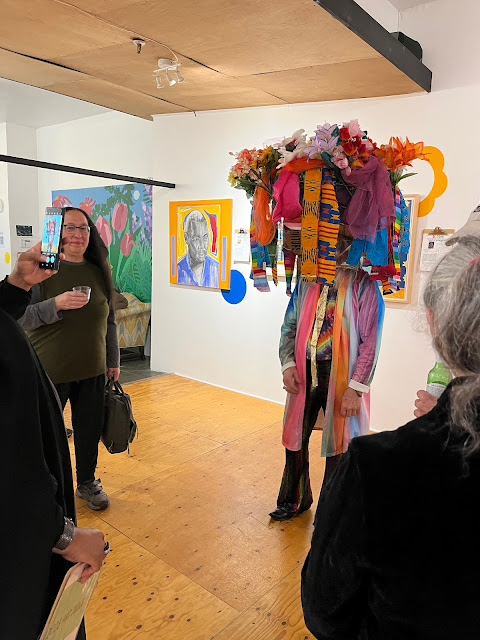
The event was a wonderful time, complete with a hat competition and trivia games, and the turnout was a sight for sore, pandemic-worn eyes.
Lots of donations!
...I mean lots! The back half of the room.
Floor 2!
Hats!
Scannable in situ. Always gives just a bit of peace of mind to double check!
I was very glad to see two bidders before I had to go!
I'm very happy to send off my work to its new owner's home (who's first initial is indeed an "A," as I sort of predicted it might be!), and I'm excited for Aferro's year to come!
I was invited to participate in a group exhibition at the Visual Art Center of New Jersey, which set out to create a visual compendium of all the flora of New Jersey's Great Swamp through post-it note illustrations. After receiving the list of plant life to choose from, I settled on the aptly theologically named ornithogallum umbillatum, more commonly known as the Star of Bethlehem.
In the vein (pardon the leafy pun) of my other drawings, I decided to play off of the sacred geometry inherent to the flowers morphology and reconstruct it as a cosmological diagram of sorts.
My drawing shared wall space with hundreds of other artists' renditions of their respective choices to make up the Plant Line exhibition.
Concurrent with the Plant Line were some other really great exhibitions exalting the natural and human-made surroundings of the region, including Jessica Rohrer's Neighborhood Watch, Matthew Jensen's Park Wonder, and Alice Momm's A Conversation with Trees:
And I was honored to discover that of the 500 drawings included in the exhibition, mine had been selected as the feature image for the VACNJ website!
Which just goes to show there is no such thing as a small part. Only small drawings of cosmological significance. Happy to be included in such a fun exhibition!
I adjusted the variables to locate the hand positions relative to the person's body rather than to the screen itself, which helped account for a variety of user positions near or far from the camera. I also added in the complete array of spoken code, and tweaked the timing of the voices for a closer unison.
Unfortunately I had to manually input all 1478 "words," but I did at least devise a way to automate the process of fitting all those entries into the necessary code blocks. By listing all the items in separate columns of a Numbers spreadsheet, I could copy and paste each element: "speech[__] = '__';" where the first space could be algorithmically numbered and the second space was the respective word in the array. Then I used a formula to merge all the rows into a single column, so that I could copy and paste the whole thing into Pages where I could systematically use Find/Replace to remove the extra spaces and replace the quote marks with straight quotes. Then I could copy and paste into Processing.
Our first performance...
was slated for Gallery Aferro in mid May, and would be followed by a second performance in Brooklyn in June. I met with five of the other participating artists to discuss the framework around the John Zorn COBRA inspired game rules that would dictate the performance.
Everyone's sound objects would be stationed around the gallery, and artists and viewers alike would be able to interact with them. We also contracted a jazz trio as a "house band," which (unbeknownst to them) would play standards and improvise in conjunction with the chaotic cacophony of all the sound objects joining the composition.
A big, occultish wheel-of-fortune style wheel would then dictate musical rules, including time signature changes, volume or tempo changes, switching instruments, offering a vocalized "prayer," playing blindly by wearing an oversized mask, using a toy sword to cut an instrument out of the music for a time, simulating your instrument's sound a cappella, or manipulating a wooden paddle in whatever less-than-sadistic way the user saw fit.
These of course became implausibly precise rules that most of the atonal instruments were incapable of following in the first place, and it added to the anarchic anti-structure of the whole ontological experiment.
setting up the wheel and the tables
My setup, a mac mini, keyboard, and kinect sensor packed into the cabinet of an amp with a monitor on top. The white tape denotes optimal range for interaction.
Some of the other projects included a delay-looped feedback pendulum, contact mics submerged in water with various crystals and rocks, a telegraph-turned-alarm bell, salvaged broken electronics out of which sound is coaxed (including a theramin!), and more.
One of the other artists interacting with my project
Molto-Allegro!
Fortissimo!
Heidi Lorenz-Wettach Hussa's repurposed theramin and other broken electronics
Jamming
There were still several challenges to troubleshoot. The biggest difficulty was programming it to account for all the unexpected variations in environment and interaction.
I was thankful my program apparently had the flexibility to recognize many unorthodox body shapes, but it often had a hard time detecting users, especially with multiple people in the frame. If their hands went behind their back the tempo would sometimes get stuck in super slow motion, essentially freezing the program. It would also get stuck after loosing a tracked user, not realizing it was no longer tracking them. Often times viewers didn't know if they were being tracked or not. And of course I wasn't thrilled by the shrunken visuals, but I'd need to adjust many of my equations before being able to size up the screen.
All of this thankfully went hand in hand with the provisional, experimental nature of the show.
Many kinks to work out before...
Off to Brooklyn!
In June we were invited to reprise our performance as a part of the "Summit: Nature, Technology, Self" conference led by the High Focus Institute in Brooklyn's Kilroy Metal Ceiling.
The venue was a gloriously defunct old warehouse, literally falling apart at the seams. It housed the projects of several other collectives and individuals, including prototypes of Terreform One's sustainable food shelters, which I got to see in person just days before I saw news articles popping up about it online!
Many groups held performances of one sort or another, including a DJ, a playwright, and an immersive projection/performance installation that involved an almost alien-mystic enlightenment "interview." It was tongue and cheek and utterly implausible and yet it was maybe the most impactful and stirring performance I've ever engaged with.
Sitting in the Queue to "interview" with the High Performance Institute.
After helping you craft your "resume," (by infusing the objects on the table with your own personal history and ideologies) I'm taken back behind the curtain to speak with his female counterpart. The psychedelic projection landscape enveloping you and the strangely empathic line of questioning slowly turns into a trancelike, swaying dance that may have changed my life. Not even being hyperbolic.
This time, we substituted our Jazz trio with a Progressive Noise Band out of Philly. The effect was extraordinarily different!
I reworked my project a bit, building in some textual user feedback on the tracking process to help confused viewers hang in there while it calibrates, and eliminated the perpetual slow motion glitch. Most importantly though, I got it to automatically abort and restart the tracking process when a user left the screen and it thought they were still there. I also built in a fail-safe nuclear option, in which one stroke of the keyboard could be used to reboot the whole program.
And it turned out I'd need it. Though the open space behind my piece's station caused some confusion in user tracking, it worked brilliantly. ...Until our noise band lived up to its name and cranked it up to 12 or 13 (11 is so 80's).
I still don't know exactly what went wrong, but the leading theory is that the sound vibrations were so intense it disrupted the computer's hard drive and crashed the whole thing. Not just the program, the whole computer. Nothing would do anything. Either that or there were so many amps and instruments producing wonky electromagnetic fields that it too messed with the hard drive. In any case, I spent a solid portion of the performance fighting with the technology and becoming a bystander. At least it had its moment in the sun beforehand, and it added to the anarchic feel of the whole endeavor.
I guess you could say it was a very Object Oriented moment for me, in the truest and most Heideggerian sense, as the tool's malfunctions betrayed the tool to me in all it's glorious Ontological dysfunction. Mission accomplished?
Lots more to figure out before there's ever a third iteration of this project, but until then, if you're interested, here's a link to my full processing code. Feel free to excerpt and adapt, just give credit where it's due.
This was a really fun challenge, and afforded some experiences I likely wouldn't otherwise get, working with the Oculus Collaborative and infiltrating Brooklyn's hipster-grunge experimental music scene. All in the name of Ontology.
This summer I participated in an experimental sound art exhibition, and in my quest to create a computer vision based Text-to-Speech sketch in Processing, I discovered there are really no good options out there.
The FreeTTS java library is more than sufficient in theory, but I could not find a Processing friendly wrapper that actually takes advantage of all FreeTTS has to offer.
Luckily,
deep in the recesses of the Processing forum, the user Kof offered this "messy class called Basnik." in response to another user baffled by the same problems.
Kudos to Kof and his brilliant tutorial. He said to "modify as you need," so I did:
I'm not a polished full-stack programmer by any stretch, but this should get the job done.
Here's a cleaned up, beefed up version of his Basnik class that allows for dynamic control of the voice, pitch, volume, tempo, range, transposition, and more.
Put all the .jar files you download inside a folder called "CODE" within your Processing sketch's folder
Open a separate tab in your Processing Sketch and paste in this class:
In your main code, use this as a basic template:
create as many instances of Basnik as you want - you can thread them together to create polyphonic effects, use variables for dynamic control of the voices, and iterate through string arrays ("String[]") of words so you can change those controls mid sentence.
I hope you find this useful. Feel free to use and adapt this and make it even better.
This past summer I had the pleasure of participating in one of the most exciting group shows I've yet been a part of. Jeanne Brasile, director of Seton Hall University's Walsh Gallery, and artist Gianluca Bianchino teamed up as the curatorial duo Wavelength. For their inaugural exhibition they examined the physics of their namesake, inviting light artists to give their take on The Particle and the Wave.
Also check out my feature interview! (a true honor given the lineup in this show)
Held at Index Art Center in Newark, the curatorial team utterly reinvented the gallery space, building walls and even entire rooms, and having all of the light in the gallery be provided by the artwork itself.
I'm honored to have been a part of this show, sharing the gallery with the likes USCO (the collective of Gerd Stern and Michael Callahan), whose work in the show incorporated video pieces borrowed from Nam Jun Paik and Charlotte Moorman (Which officially makes me 6 degrees separated from Kevin Bacon, but only 2 degrees from Nam Jun Paik!).
I'll probably never forget Jean relating Gerd's story of escaping Germany during WWII, trying to hack it as a poet and ending up impoverished, meeting Alan Ginsberg in a mental institution, getting kicked out, and then finding his way with likes of John Cage, Harry Partch, Maya Angelou, and the Black Mountain School (this is the tame version of the story).
As if that weren't enough, I was also in the company of heavyweights Stanley Casselman, Carol Salmanson, Ryan Roa, Andrew Demirjian, Jain Kwak, Greg Leshe, Sunil Garg, and my former MFA comrade Christine Soccio Romanell.
Hyalo 3 (WaveParticle)
With the gallery being entirely dark, it was a perfect occasion for me to develop another iteration of my Hyalo series.
This series is an offshoot of my projection negation work, combining projected and painted color. But instead of negating each other, the Hyalo projects blend to an iridescent, ambiguous third color that resembles stained glass, and seems to float at an indeterminate depth on the wall.