Tagline

The Studio of Eric Valosin

Thursday, January 16, 2014

Interactive Negation Experiments

I've been experimenting with merging the interactive computer programming I've used in projects like Luma and Venae Cavae with my projection negation technique from UnKnowledge or Triptych. Here's my first foray:


Above you see a board on my wall with a painted blue square on it. It's mounted on a stack of milk crates (these are big budget experiments, I assure you) that also houses a Kinect sensor.

Now ordinarily I would project onto that a still image with colors I've calibrated in photoshop to negate out the painted imagery (using complementary blends of additive and subtractive color on a matching gray background). The user's shadow then reveals the painting upon obstructing the projection.

However, this time, I wrote a program in Processing that would allow me to control the location and rotation of that projected image (in this case an orange square) by waving my right hand in real space. It's location corresponds with my hand's x and y position, while its z position (how close or far my hand is from the Kinect) controls the rotation of the shape. This way I can manipulate the occurrence of the negation with my hand!

Here's a video (you'll have to take my word for it that the color negation is seamless in person - the camera lens picks up the reflected colors differently than our eyes and therefore tints the blended color a bit off in the video. The grays are a truer match in person.)


Not sure yet where this will take me, but I imagine a large installation in which the person can manipulate the projected image with their body, which causes the negation, but while simultaneously being in front of the projector and thus concealing the negation and revealing the paint, in a sort of convoluted, partially self-defeating sort of way. The next trick will be getting it to work with multiple viewers (right now it relies on user-calibration in a specific pose to detect the user's hand...)

We'll see what comes out of this, but I essentially just wanted to see if it could be done... 

It can.

Blessed Through the Ether

It thrills me that the United Methodist Church is wrestling with these sort of issues.  Take some time to read these articles to get a sense of the debate, before and after, and from mostly objective standpoints (to their journalistic credit). Then you can hear my mostly subjective and biased response... Click the image for the whole article.

[click image for full article]

and another take on it with some excellent quotes...

[click image for full article]
As we push further and further into the digital age, what does it mean to commune? Can physical distance limit God's consecrating reach? Apparently, for now the Bishops of the church say it can, resolving last month to halt virtual communion efforts:

[click image for full article]
Should we really be pushing a resolution that prevents willing Christians from receiving communion because of the medium that enables it? It seems absurd to me that you can say the internet "trivializes" the holy. By proxy, Jesus healed the boy in Capernaum from over 20 miles away (John 4:51). Is it any different to think that God might bless sacraments from over 20 miles away by internet proxy? Did the distance between Capernaum and Cana "trivialize" the healing? What's the difference between the space between my hand and yours, and the space between my computer and yours?

There is much validity to the fact that the human touch and intimacy is changed if not removed, but that is a condition to be aware of a treated judiciously, not taken as a reason to shut down the whole enterprise. Do we stop praying for someone because they're not there to hear us do it and benefit from the support of our presence? No, we pray. And then we go visit them if we can.


Friday, January 10, 2014

Meaning in Meaninglessness - A Mystical Reading of Ecc 1:2

Spoiler Alert: 

Everything is meaningless. The good news is, that means everything's ok. Really, the true spoiler is that through a bit of exegetical contortion we see that this famous passage from Ecclesiastes actually forshadows the whole story and redemptive turn of Ecclesiastes. Put simply the Teacher could have saved himself the trouble of writing so much of the rest of the book if he shared the full weight of the words he so carefully chose.

Ecclesiastes seemed like the right book to begin a series of mystical readings of the Bible. It is rife with paradox and counterintuitive proclamations, and seems to say so much without really saying much of anything; a perfect Mystical Text! The JPS Bible Commentary's volume on Ecclesiastes by Michael V. Fox also names Ecclesiastes as "the closest the Bible comes to Philosophy, which is the intellectual, rational contemplation of fundamental human issues, with no recourse to revelation or conventional tradition" (xi). There's something charming in that to me because despite it's isolating honesty it somehow still ends up canonized, becoming conventional tradition, and being a source of revelation to millions.

Everything Is Meaningless

Tape up your ankles ladies and gentleman - we're about to launch into a routine of etymological, hermeneutical, exegetical, linguistic gymnastics the likes of which would break both ankles of the best olympians (...a little 1996 Kerri Strug joke...). Let's begin. Koholeth, translated "the Teacher," pronounces,

Everything Is Meaningless (Ecc. 1:2)

We know this is a roughly bastardized translation, as even the best Biblical texts often are. Often we may have heard this passage more literally translated as Everything is Vanity, preceded by the phrase vanity of vanities in place of the more common utterly meaningless. What they don't tell you is HOW they arrived at "Vanity," and what that really does to our reading of the word "Meaningless"

So I turned to the original Hebrew, transliterated as:

Ha-kol hebel (Ecc. 1:2)

The first part is easy: Ha = The,  and Kol = all/the whole of it.  The next word is where things get interesting. Hebel directly translates to Vapor or Breath. So how did we get "vanity" from that? Well, conjugated as a verb, Habal means to act as vapor. This gives us the idea of the empty, substanceless actions we'd call "vain." So "Vanity" in this case means "acting as vapor," and thus "Meaningless" takes on a meaning of "having no substance; being close to nothing."

So, in a strikingly apophatic turn of events, we can reinterpret the passage:

Everything is Meaningless

becomes

The whole of it [is] substanceless/nothingness

So What? Let's Ask Cain and Abel

So we've reconstructed a literal interpretation of 1:2, but how should we feel about this? Is this really as bleak a proposition as it seems? I think not...

Interestingly enough, Hebel happens to be the exact word given as a name to Adam and Eve's second child, which we have come to Anglicize as Abel. Abel is thus named "Breath" or "Vapor," or essentially as we discovered, he's named "Nothing." One source illustrates it quite poetically saying, 
The names of important characters in Genesis are usually explained while they are given, but not Abel. Here is an individual who is named Whiff, who is not even worthy of an name-explanation, and who has himself done in by his brother Cain, before he can even say a word! If God hadn't accepted his offering (Genesis 4:4) and Jesus hadn't proclaimed him righteous (Matthew 23:35) Abel would make for a very sad character.  
And what of Cain? His name takes us for quite an etymological romp. Cain (or Kain) is usually translated as "reed" or "spear." This is usually where the interpretation stops; makes sense, right? The one named "Spear" kills the one named "Nothing." However, as a verb, the word has come to mean to gather or acquire. Yet, most literally it means to forge (a spear perhaps - and to forge spears is to create and thus acquire or gather them).

Take it a step further, and combining the roots (to gather and reed/spear) gives us the word for to build a nest (As in "to gather reeds"). So then:

Cain kills Abel

Kain kills Hebel

"That which Gathers" kills "Nothingness"

A new take on the notion, but it seems intuitive enough... you can't have nothingness where something is gathered, right? So again, I ask the qualitative question, how should I feel about this? Our culture tends not to value nothingness. Am I to pray for a nest, that I may avoid oblivion?

Interestingly, whereas we would idiomatically say something like "he's wailing like a banshee," the Hebrews might say something like "he's crying like an eagle building a nest!" You guessed it, the word for "cry" in this case is Kenite, to lament, from the root Kain, an eagle "gathering reeds!" Onomatopoetically, this is where they get the word we translate as "lamentation!"


So am I to pray for the ability to Gather? It seems not, for to gather is, connotatively, a lamentable thing! Cain is given a name that carries a poetically negative connotation, fitting of the vilification he'd endure.

And remember from the quote above, that Abel would be nothing save for his exaltation by God in Gen 4:4 and Matthew 23:35. God accepts his offering in Genesis instead of Cain's, saying he will be "elevated" (Hebrew Nasa: to be lifted up; accepted; to have honor; to lift one's countenance with confidence) for his right actions.

Jesus reinforces this in Matthew, calling Abel "righteous" (Greek dikaios: equitable in character or act; just; innocent; holy).

So it seem Cain may have triumphed over Abel, but Abel is the favored one and Cain is despised. To gather is lamentable, but to be as nothing will earn you the favor of God!

According to this, I should pray to be like Abel, maintaining my nothingness, and resisting death by way of the gathering!

Where Does This Leave Us?

Ok, lets stay on track here. Ecclesiastes 1:2:

The whole of it [is] substanceless/nothingness

This is not a lamentable thing. In fact, that the whole of it is meaningless is indeed to have the favor of God, and to be seen as righteous. Qualitatively, we can substitute "Meaningless" with "Righteous by way of its emptiness."

Should my prayer therefore be, "God, make me nothing, that I may be righteous?" Sounds surprisingly orthodox, really. After all, won't the last be first and the meek be blessed (Matt. 20:16, 5:5)? Indeed, but let us not forget the first part of Ecc 1:2. Remember that easy part in the beginning? Ha-Kol. The whole of it. I need not pray to be meaningless because the whole of it already IS meaningless!

Everything is Meaningless

now becomes:

Everything is already as it should be, Favored and Righteous, by way of it's Nothingness

Everything is already in a favored, redemptive state. We need to just accept it. And isn't that in the end what the Teacher, Koholeth, discovers in Ecclesiastes? That we must be content to live in the moment as it is, working for the sake of the work, and remembering and reconnecting with the One who created us from dust, that we may return to dust. Everything is as it is, just as it is supposed to be. We need only to accept it. 

Conclusions

This rings of the a-teleology of Zen or the emptiness of Eckhart's Christian mysticism. But really, it sounds very simply like Grace to me. We are already redeemed, forgiven, accepted, and made righteous. We need gather nothing, rather we must remain nothing - empty, dying to ourselves so that the Breath of God (Pneuma of God? Rather, Hebel of God...) may abide in us. We need only accept it as it is, just as we are accepted as we are. We are in fact given our most precious meaning in our meaninglessness.

And there you have it, the whole of Ecclesiastes (and more) couched into the very linguistic structure of the very first pronouncement of Koholeth. It may seem an unnecessarily radical exegesis, but I for one think he knew what he was doing in choosing the precise language he did. After all it says, "the Teacher searched to find just the right words, and what he wrote was upright and true" (Ecc. 12:10).

But don't take my interpretation as gospel, for we are also told that the Teacher has given his words, and to "be warned, my son, of anything in addition to them. Of making many books there is no end, and much study wearies the body" (Ecc. 12:12). 

So in the end, even this blog post is Meaningless.


Thursday, January 2, 2014

NOW, Luma

Here are some images of my interactive projection and glow paint project, Luma, as well as a few of the exhibition for which it was created: Fuse Art Infrastructure's 3rd installment of concurrent solo exhibitions and projects in the NOW series at The Cigar Factory in Allentown, PA.

To read more about the creation and conceptual background of Luma, go to this post and scroll down to the section beginning "Luma: Arduino." Or, if you haven't arrived at this blog post via my website, click here to see a video about Luma on my site.


The premise of the show series.

Outside my room - Item list, mailing list signup, business cards, and my monograph Unknowing the Unknowable

Outside my room, featuring my 4 pieces from my Cosmos on Gray series

...Two of which were newly created for this show

Inside the room, my two new Hyalo pieces.

The wall opposite the entrance of the room, with Hyalo 2 (Rose) on the left, and Luma in its phosphorescent state on the back wall.

Luma, glowing.

Luma, during the projection of the interactive video

There were several base images it selected randomly from, then superimposing the viewer in real time as a silhouette which reveals a view of the room behind the wall (Brian Wiggins's exhibition)

an example of an image of the Cigar Factory taken from Google street view
the glow produced by the previous image
A similar shot, but as an original photograph
detail
detail of glow


Click here to return to Luma on ericvalosin.com

Saturday, December 21, 2013

My 100th Post! This Warrants a Pilgrimage

Ladies and Gentlemen of cyberspace (and I guess those that inhabit physical space as well), I'm excited to be posting my 100th blog entry on Art:[b]logos since it began just about 2 years ago! I thought I'd better do something special for this post beyond my ordinary self-indulgent blather, so I decided to take a pilgrimage out west, in order to experience first hand something worth writing about.

My journey through the wilderness was long and hard (5 hours on a plane with an 18 month-old is on par with a trek through any desert in my book), but soon I arrived in the promised land: Orange County (That's Biblical, right?).  Ok, so I suppose the real reason for the trip was to visit my 2 month old nephew and his family, but it afforded me a great opportunity to check out some of the SoCal art scene, and I knew exactly where I'd start. I indeed felt a bit like Moses' followers arriving in the (actual) Promised Land as I stepped into the towering entryway to LACMA and retrieved up my program for the hallowed James Turrell retrospective!


As you may know Turrell is, after all, essentially equivalent to Moses as far as mystical light artists go. Having experienced Aten Reign at the Guggenheim, I was stoked to be able to explore the two buildings worth of work LACMA dedicated to this projection prophet.

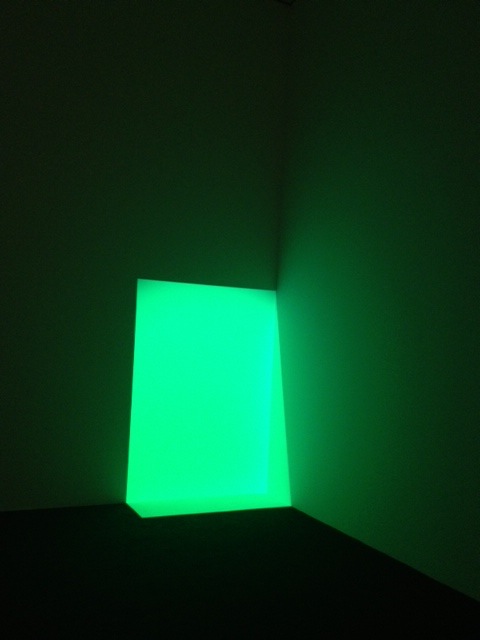
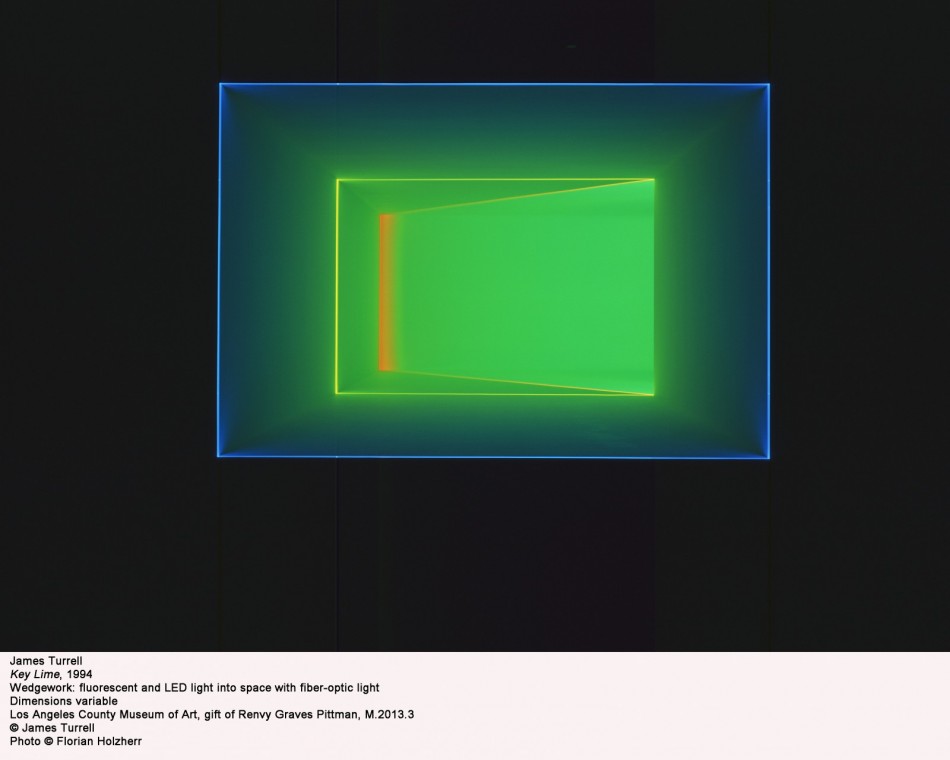
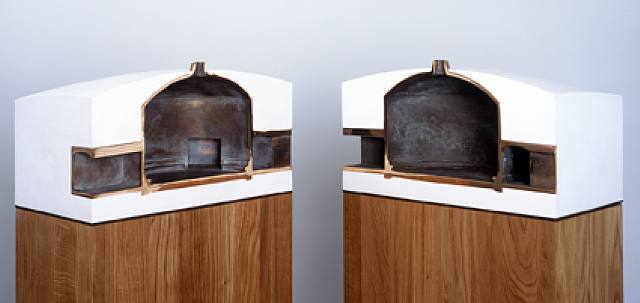
The work on view spans roughly 4 decades (pictures below courtesy of google image searches, as no photography was allowed inside the exhibit), ranging from his early projection pieces...


... and prints and drawings...


... to his holography work...


... to room-sized light pieces and wall-cutout pieces...


...to the legendary Roden Crater...


... but the piece that took the cake was...

the Ganzfeld room.

As you approach the installation, you're instructed to take off your shoes and don a pair of paper medical booties to retain the pristine whiteness of the chamber. After ascending a velvety black stairway, you enter into a chamber with no discernible edges or corners, with a backlit hole cut into the far end of the room. 


You don't see the source of the light, just the light itself, shifting through blues and pinks and whites and purples. The result is an soft, modulating color that floods the room, so thick you feel like you could drink it. You know that feeling when you walk out of the shower and the steam in the bathroom is palpable? That's how the light feels!


What's even weirder is what it does to your perception. You know how video projections can have a chromatic aberration when out of alignment in which you get a red fringe on top of a figure and a blue fringe underneath? When someone walks in front of you you actually see this effect on the outline of the person, produced in real life by your eyeballs! What's more, if you walk sideways towards one of the walls, you lose all bearings and you can no longer tell where you are or how far you've walked until you suddenly feel your foot touch the gentle slope of the curved wall edge and you realize the wall is 3 inches from your nose. All you see is an infinity of color.

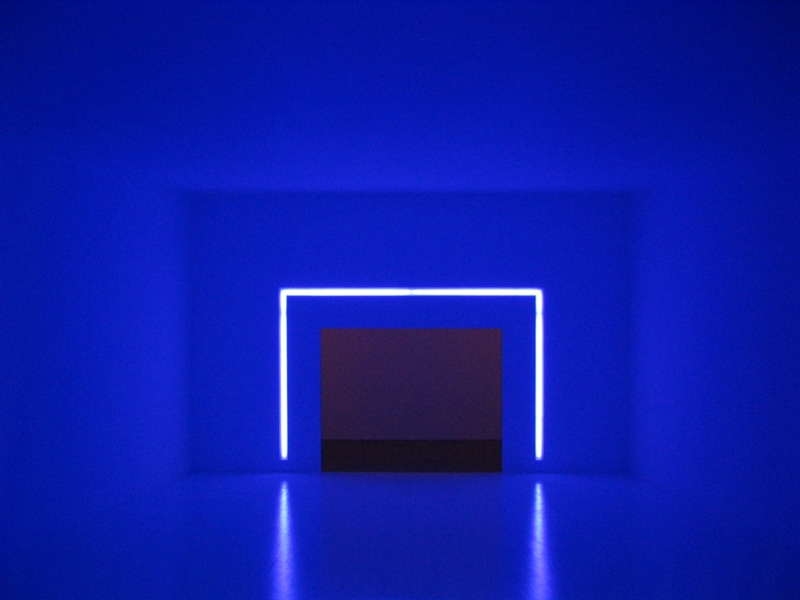
As if that weren't enough, when you turn around, inundated by this color, the white wall of the entry room opposite the hole that you climbed in becomes a thick, dark, floating greenish rectangle because of the after-image burned into your eyes from the color in the room!

this isn't the ganzfeld room at LACMA, but you can get a sense of what I mean.
Well worth the price of admission, the Ganzfeld room has left me with one question as a light artist: where the heck to you go from there?!

It's an utterly surreal and disorienting experience that I highly recommend to everyone. The only drawback is the time limit they place on experiencing it. Get your tickets now - the retrospective is up for a few more months.

So now I have much pondering to do. The next step for me seems to be translating my projection pieces from an interactive object of sorts, to an immersive environment. I wonder, what would be my Ganzfeld?

Well,

After rounding off my trip to LACMA with a healthy dose of Chris Burden and Calder, my pilgrimage extended to the typical tourist spots: San Diego Zoo, Santa Monica Pier, Disneyland, and the very first Trader Joe's in Pasadena (I'm a bit ashamed to say so, but being the store artist I am I felt I couldn't leave without stopping by), and lots of quality time with my new nephew and the gang (which was of course the goal in the first place).


100 blog posts down, and I feel like Turrell has given me a glimpse of a trajectory worth 1000 more posts. Shooting for the stars is one thing (for which Turrell has quite literally set the precedent, in the case of Roden Crater) and a career like his seems almost mythical. So, inspired by his mystical leadings, I'm content to set my sights a bit closer - say 3 inches in front of my nose, right about where the wall of the Ganzfeld disappears into eternity, far beyond the stars, but closer at hand than my next day in the studio.