I am bit late on posting about it now, but last thursday I loaded up my car to install my interactive projection piece Dissolvation. (If context eludes you, you can catch up by going to my first post about the project.) I'm super excited about all the work in the show. There are a ton of really innovative, captivating installations and projects, including an immersive cosmological diagram that takes up half the gallery, line drawings created by mouse tracking software following the artist's day job activities as a photo editor (which give me big apophatic goosebumps all over in the sort of "why didn't I think of this first!?" sort of way), life-size cardboard ejector seats halted from hurtling into a projection wall by bungee cords and chain links, and video projection onto a relief black hole (created by a friend of mine, Gianluca Bianchino, who I'm very happy to get to show with).
During my test installation at home, you may recall I had to rig up a makeshift armature to affix the masonite boards to in order to get my project to fit on my wall. As if to scream that everything indeed happens for a reason, it was a VERY good thing I had that experience...
As I showed up at the gallery, I was greeted by a slight surprise:
Due to a typographical error and honest misunderstanding, the wall allocated to me turned out to be half the size I expected, and a good foot and a half smaller than the width of my project! As I racked my brain for a solution, the only thing the curator could offer me were some extra planks of wood leaned up in her office (...sounding familiar?)
So I began reconstructing - almost exactly as I did in my home - an armature that would hold my project and affix to the wall, extending its holding capacity to the necessary size! I have to thank the curator, Jeanne Brasile, for being extremely accommodating and helpful as we sorted out the mixup and worked for the solution.
a couple beams across to extend the width
adding the circle components
and finally the central mandala gallery form
After a few innovative hours, I was caught back up to the starting line and was able to begin installing the projector, computer, and camera, all which thankfully went off without a hitch.
Then to begin my ritual of aligning the projection and finding the crop points in the video capture (with some much appreciated help from one of the gallery assistants)
And we were soon ready to go!
The piece actually ends up being site responsive in yet another way I hadn't foreseen. Depending on the ambient light in the room, the colors of the projection alter. As the sun began to set, the colors became darker and bluer, and I expect when the gallery is lit for the colors to become slightly more natural, and with whiter highlights more of the time.
This project holds a lot of potential for performance too. One interesting discovery was that the delayed capture holds a memory of any light shone on the projection surface. For example, this shot below is from about 15 seconds after my camera had flashed its red autofocus light at the subject (The red light is no longer shining at the moment this photo was taken)
The possibilities for light painting are intriguing...
It will also be very interesting to see how the project behaves over the month and a half it will live at the gallery, constantly compiling and dissolving video footage. My suspicion is that each day when the projection gets turned off it will essentially reset the coloring of the projection, allowing it not to get too muddled. Who knows, maybe something unforeseen, strange and beautiful will happen!
Come see the show on Thursday 1/22, reception from 5-9 pm!
The digital component serves the dissolve part adequately enough - the dis-solvere part - the part that pulls the viewer apart into his dividualized, digitalized pieces. But that's only half the equation. Being the good negative theologian I am - I'm apparently being very generous in ascribing myself titles this week; last post I was a "post-human post-structuralist relational metaphysician," if memory serves... - anyway, being a good negative theologian, I know that hand in hand with the solvere comes the salvare - the salvation, the recollection to wholeness (sozo, shalom). Only by being pulled apart and lo(o)sing the self may one find the self and be made whole. A dissolving salvation.
Given the implicit secularity of the gallery setting, I though it important to provide a physicality to the project that would be charged with a bit of salve. For this I turn to the meditative spiritual image, the mandala.
I've used this idea before, in Luma, turning the gallery floor plan into its own mandala structure. After all, conventional mandalas are in fact flooplans of Buddhist temples and such. I resolved to make a site specific mandala to be the stage for my interactive recursive video projection.
I began sketching...
...and refining, converting doorways into the iconic gate shapes and simplifying the geometry into the recognizable circles and squares of mandala imagery.
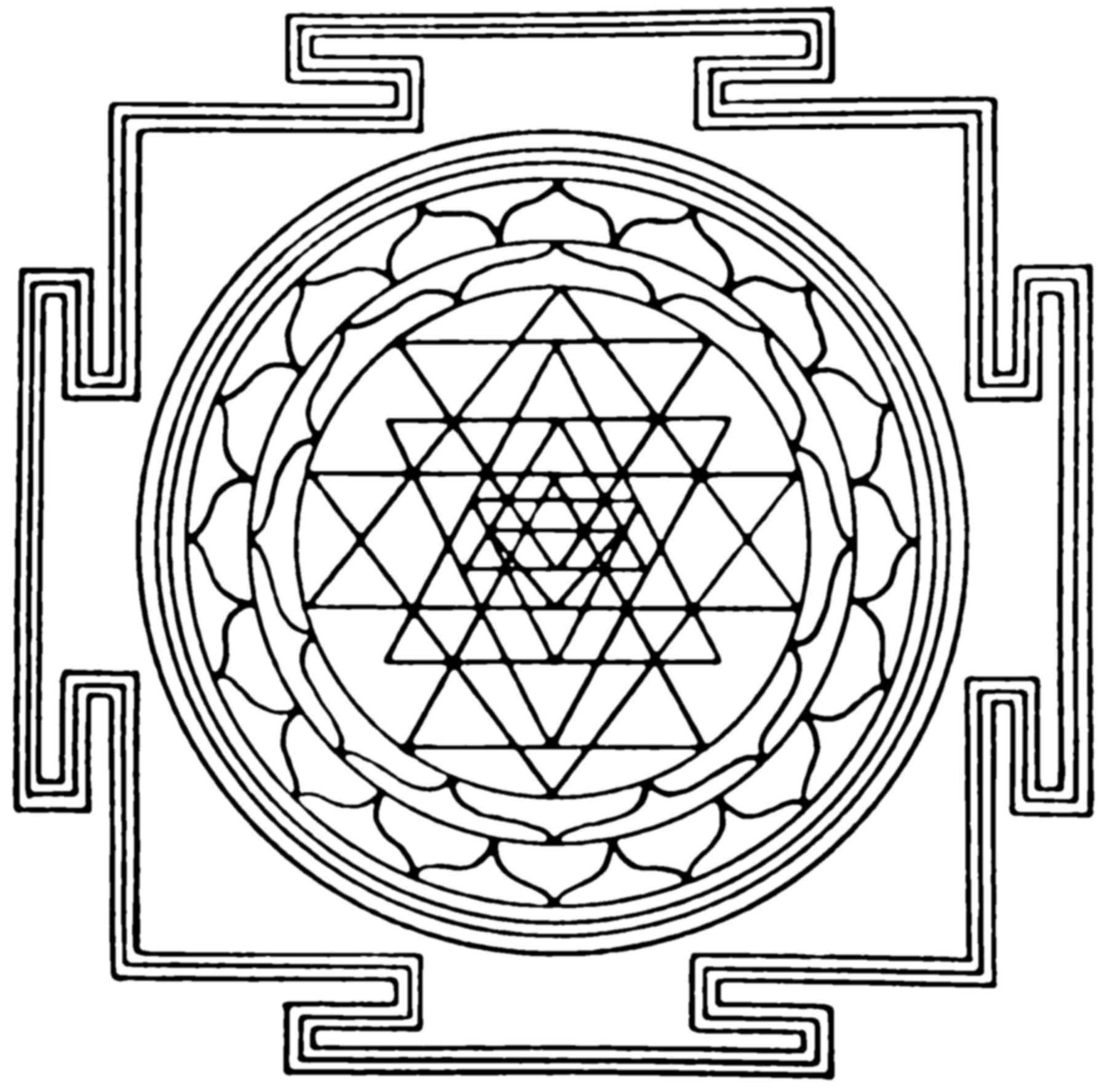
(taken from Wikipedia)
And I began cutting the shapes out of masonite. Full disclosure: I decided to make it in pieces both because I thought it would connote a bit of pixelated modularity (a 4:3 aspect ratio of masonite squares), and because that's the only way it would fit in my car for installation!
And I began painting it in a way that was as subtractive as an additive method can get, building up white strokes on top of a darker background, harkening perhaps to the whites of Ryman, Malevich, or Rauschenberg.
And lastly I inscribed in white oil around the borders the code that runs the program to be projected onto it.
SO,
Now with the digital done and the physical prepared, I was ready to combine the two and see how it worked.
Naturally, because no installation would be complete without some drastically bootlegged, jerry-rigged, hack of a solution somewhere, I had to get creative with installing this at home, since I lacked any white walls large enough to accommodate the piece. Armed with Gorilla Tape, 2 screws, and some wood planks I found in the garage, I began propping together an armature to hold the masonite pieces, and filling in the faux-wood paneled gaps with white paper to simulate a gallery wall.
Tomorrow I'll be installing at the gallery. But until then, I'll leave you with these catalog images as a teaser! Come experience the real thing on the 22nd!
To kick off 2015, I've been invited to participate in a group show on the subject of infinity. Below is a short chronicle of the development of my project for the exhibition, but if your patience isn't so infinite you can jump here to read the press release, and come to...
GETTING TO INFINITY
@ SETON HALL UNIVERSITY'S WALSH GALLERY
On view 1/20 - 3/15
Opening reception 1/22, 5-9 pm
Infinity was a curious subject to ponder for this quasi-post-human, post-structuralist, relational metaphysician. As I continually aim to draw together contemporary thought and technology with the mystical and phenomenological, I thought back to a book by Brent Waters called From Human to Posthuman: Christian Theology and Technology in a Postmodern World. He discusses the trans-humanist desire to bridge the gap between the "good" and the "necessary" (the eternal and the temporal) by achieving technological immortality.
Infinity takes on a new metaphysical depth when post-humanism enters the equation. The dissolve of one's self into cyberspace is in some way an extension of our desire for the infinite - infinite space, infinite possibility, infinite dividuals of the self, to borrow from Deleuze (if subtracting his power polemic).
What if our endeavors towards this digitized infinitude were to marry with our other endeavors toward metaphysical infinity - namely interactions with meditative space? This is one of the prime motivators of my practice.
I thought back also to a prior project of mine, Circle, in which a custom designed table and interactive video projection (using a recursive video capture delay, projected back onto the drawing surface being captured) allowed me, in performance, to literally interact with my digital self and synchronize the two dividualized spaces into one meditative act: attempting to draw and erase a perfect circle.
I wondered if this idea could be translated off of the table and onto a wall so that anyone might be able to interact with it instead of just me in performance.
So I started with the video delay patcher I had written in Max/MSP for Circle, translated it to Processing (oddly I found myself more comfortable tweaking and coding in Java than Max's visual interface), and set up my projector. Originally the camera was aimed at the paper on the desk and then rear projected the image from below. That created the recursive infinite regress, which I really liked not only for its relevance to the topic, but for its aesthetic quality of eventually dissolving the digital selves into the glowing blue mush of the compounding projection light. In this iteration I used the laptop's iSight camera (soon to be replaced by an external webcam) and pointed it directly at the projection
That yielded this infinite regress:
However, what made the Circle experience so magical was that the projected image and the captured image were exactly lined up so the proportions of each iteration in the regression remained the same (no perspective effect, just an infinite compilation of overlays). So I designed this test, using a stock image and Processing's texture mapping function
Top right: original image. Bottom left: testing the shape to be mapped to, which fills the screen. Top left: the finished crop, mapping the cropped image (to simulate cropping to the projection screen) to the whole output screen. Bottom right: empty quadrant of black stuff.
With it, I was able to digitally crop the video capture to the edges of the projection, yielding something more like the intended effect:
Playing around with a two-way mirror. Unrelated to this project, but I wanted to tinker...
With a few more tweaks I was then ready to start considering the physical side of this digital-physical metaphysic... Spoiler alert, the below video has glimpses of what I'm talking about. (Stay tuned! Cue curtain)
Ruminations on my recent solo exhibition at Andover Newton Theological School's Sarly Gallery. I invite you to enjoy it in person through Dec. 31, 2014! If you'd like to follow the development of this exhibition from its inception, you can do so at these links to prior posts:
Interiority is a longstanding mystical path to noetic Unity. Many spiritual disciplines help center us and point us to our "true selves." But what happens when the interior is located outside of the self? What happens when the center is decentered? Meister Eckhart taught that we must lose the self in order to find the self, and in finding the self, lose it to the selflessness of unity with the Other. Can the interior/exterior space of an environment become one with the interior/exterior space of our own bodies? Can we dissolve the thresholds between Self and Other? Can our modern technological interfaces facilitate an awareness of Within and Without on a new level?
The Sarly Gallery at Andover Newton Theological school is rife with liminality. There is very little interior or exterior space to speak of. Rather, the space almost entirely comprises thresholds - mediators between the outer and the inner. Only one of the four walls is actually much suitable for hanging art in the traditional sense. The second wall is almost entirely a doorway and a few windows, the third full of recessed, frosted-glass windows cut almost apologetically into the wall to hint at the veiled outdoors and cloak the interior space, while the floor-to-ceiling grid of square windows on the adjacent fourth wall bleed the gallery and exterior courtyard together.
These glass mediators became to me screens, reminders of our heavily mediated interior/exterior lives. My exhibition, Without_Within, occupies this liminal space between the outside and the inside, between the self and the other. The show comprises 5 pieces of work: two site specific installations, and three accompanying 2-D works.
Without_Within
The interactive window projection installation views the activity within the gallery space and projects viewers in real time into the imagery projected into the eight recessed, frosted windows on the left-hand wall. The imagery in each window arranges viewers as translucent, figurative color forms that repeat in near-infinite regress towards a vanishing point. The composition of each window is unique, and in many of them more than one viewer overlaps within the same space. The windows are viewable from both inside the gallery and outside.
The title takes the expected dialectical opposites and bridges them with the a-grammatical, techno-connotational underscore. We locate ourselves either Without or Within. Or perhaps we are possessive of both the Without and the Within. Or perhaps we must also be Without the Within, losing the self to find the self. Within and Without are found in - and in relationship to - each other, and yet abolish each other. They are and they are not. The dialectic becomes unstable and the viewer may grammatically reconstruct the title to fit their experience.
.windows/Sarly
This installation transforms the back wall of windows into something between stained glass and a pixelated screen. It becomes a colorizing mediator between the inside and outside, a transporter of light between the two. The title is conceived to be reminiscent of both literal windows and their computer namesake, with the addressable location happening to be here at the Sarly gallery. If one really wanted to read into it, there is a further layer of wordplay in that the entire title is formatted as an extension, following a dot, drawing parallels to the windows' role as medium/mediator - i.e. McLuhan's famous declaration of a medium as an "extension of man."
The colors are selected for their ability to blend in surprising ways, especially the complementary colors that gray out the landscape or the light streaming through. They also happen to serendipitously coincide with the colors in the stained glass logo of the Rabbinical School that resides on the campus.
Cosmos On Gray 1/0 and 3/0
I chose these two out of the series of erasure drawings which are inverses of each other. Figure and ground become lost and the interior and exterior of each composition negates that of the other. For more info on these, see here
Meditation 1.1 (Thusness, Elseness; Omnipresent)
I selected this one of my series of QR code mandalas for it's ability to abolish the interior space of the centralized "truth" by shooting the viewer out into cyberspace upon scanning. Every time the viewer scans it it yields a different random destination. For more info on it, see here
Merging the Self and the Other
Can selfhood and interiority be a corporate experience? The exhibition constantly strives to bring people into relationship with and awareness of others. Gazes are met from passersby on either side of the stained glass wall, and people literally merge with each other in the projection windows. In the majority of these windows, there is not a 1-to-1 viewer-image relationship. If you stand in front of window A you may find yourself showing up somewhere across the room in window F. You and another person, even someone just outside the gallery, may end up occupying the same virtual space in the window, where your colors blend together. As viewers explore themselves in these windows, they inevitably encounter the other, and it becomes a corporate, active contemplation.
Delocalizing the primary viewing space
What if the gallery wasn't the primary place from which to view the exhibition? What if the show were, on occasion, meant to be viewed from outside the gallery? Given that the exhibition is on view through the winter, there will be viewing hours in both daylight and moonlight. The installations are configured in such a way that during the day .windows/Sarly is lit up brilliantly to the viewer inside the gallery as colored sunlight floods into the room, while Without_Within are mostly washed out and invisible. The viewer outside the gallery at that same time however, would see Without_Within quite clearly rear-projected onto the exterior frosted windows, but .windows/Sarly becomes dull and darkened.
At night however, the viewing situation inverts, with Without_Within becoming primarily viewable from inside the gallery and .windows/sarly lighting up beautifully when viewed from the courtyard outside, flooding colored gallery light out onto the grass and shrubbery. At no time can you see the entire exhibit without exiting and entering, crossing the threshold between outside and inside. There becomes a sort of apophasis of the unknowable whole.
Interior Exterior Space and Exterior Interior Space
The whole becomes the part, and the part becomes the whole. The viewer finds his interiority in the analogous interior gallery space, made manifest and complete only through experiencing both what's bodily and architecturally exterior. The Other becomes the Self, and Self expands to encompass the Other. The viewer is brought into renewed awareness of Self by way of renewed awareness of the space and the Other, and vice versa, encountering the latter out of a search for the former. The absolute is abolished and the relational takes hold.
We find ourselves, through this exhibition, in the liminal spaces. The windows become thresholds not only between inside and out, but between physical space and digital space, between the mind and the body, between our self and others' selves. Following McLuhan, I hope these mediators do indeed serve to "extend" us into territories previously unexplored and unconsidered.
I'll leave you with these pictures from the Opening Reception. Enjoy!


%2BAdjusted.jpg)