Tagline

The Studio of Eric Valosin

Saturday, August 8, 2015

The Threefold Fourfold, in Twofold Fivefold

After a site visit and some major collaborative effort with Christine Soccio and John Spano, the three of us began devising individual projects that would feed off of the Fourfold exhibition's collaborative spirit. Our task was to imagine that each other's practices were our own, creating a conceptual mashup of the three of our practices, as funneled through our own unique set of tools or media.

I decided to do this with a couple of QR mandala drawings, as well as a new projection negation installation.

The entranceway of the gallery provided a perfect opportunity for such an installation since it was a liminal space that would force viewers to unwittingly engage with the piece as they walk past it to enter the space, blocking the projector and revealing the negated imagery in their shadow.


As with nearly all gallery spaces, wiring was a particular challenge. The only 3 prong outlet happened to be up here in the ceiling! Not something that a few extension cords and surge protectors can't fix though...
I decided the imagery would consist of a stained glass window made up of the Penrose tile pattern and Ammann grid from Christine's practice, featuring a hazmat suited "saint" of sorts out of John's practice.

 I had originally mulled around ideas of making the whole thing digitally interactive as well, incorporating live video feed. I even went as far as to code some experiments:


But ultimately I decided to forgo it for a more streamlined effect. Too much new media is not necessarily a good thing, and there would already be a lot of potentially confusing technology in this show. So instead, I horizontally doubled my original design to better fit the space and end up with bilateral symmetry, the left side using the Ammann Grid pattern and the right side using the Penrose Tile pattern (which geometrically emerge from each other when doing the nitty gritty tessellations of the patterns)

With that settled, I set up my pedestal, projector, and computer, and started going at it:

I've now gotten the process down to a science. Step one, project the image in-situ

Step two, begin masking off the image on the wall.

...very meticulously


5 hours of painter's tape later, I was ready to begin painting, step three.

Using the projection as a template, I begin laying down a few coats of the painted colors

partially done

With the painting complete, it's time for my favorite part...

...peeling off all that tape! There's something very satisfying in that "big reveal" moment of seeing the tape come off


And at long last, I'm ready to calibrate the projected colors to begin the negation process. This of course necessitates stabile ambient lighting, and my collaborators were very gracious in getting their lighting set even before all the work was hung so that I could get started on this.

half calibrated

I toyed with having each side negate differently, one side when the shutter for the main collaborative projection was open, and the other side when the shutter was closed, but it turned out not to effect the overall ambient light that fell on this wall all that much. So with no appreciable difference, I decided to keep the "leading" within the stained glass image and calibrate it all to negate together.
 And this is the result:


And thus we have it, a three way collaboration on the concept of the Fourfold, in bilateral symmetry encompassing fivefold symmetrical patterns. Or in other words... the Threefold Fourfold, in Twofold Fivefold!


For a look at the other projects in the Fourfold exhibition, check out my other posts linked below.


A Directory of other posts about this project:

THE COLLABORATION:

Fourfold - A Collaborative Exhibition - our first site visit and the beginnings of our concept for the show

Fourfold Collaboration - building and installing the main collaborative installation

INDIVIDUAL WORKS:

Fourfold - Meditation 1.4 - Behind the scenes of my site specific drawings for the exhibition

The Threefold Fourfold, In Twofold Fivefold - Behind the scenes of my fourfold projection negation project (You are Here)

FINISHED PROJECTS:

The Finished Fourfold: Collaboration and Multi-Site Exhibition - An overview of the finished exhibition

The Final Fourfold (Four Now...) - Images from the opening reception and other events


Friday, August 7, 2015

Fourfold Collaboration

On the off chance you've actually come to this blog post chronologically, I apologize for the lengthy delay. But on the far more likely chance you've come to this post entirely anachronistically, then it's right on time! A few months ago now (or not, as the case may be) John Spano, Christine Soccio and I embarked on a collaborative exhibition called Fourfold at Solo(s) Project House in Newark, NJ.

It began like this:


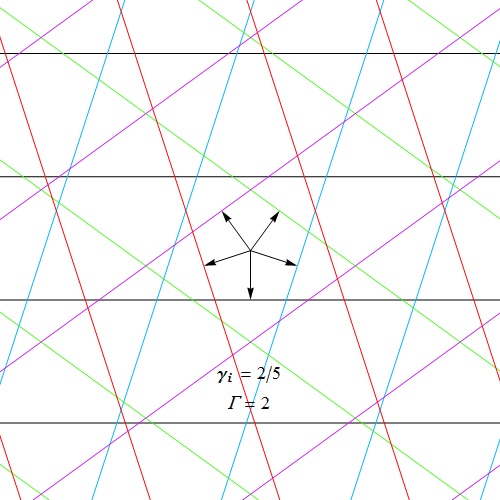
We began with Christine's Ammann Grid and Penrose Tiling, which she'd been working with quite a bit in her own practice. These are aperiodic, non-repeating patterns that, through their connection to quasicrystals and diffraction patterns, have much to do with the underlying makeup of reality.

We began to ask ourselves how we could collaboratively compile the five layers of the grid, each layer being informed by our own practices, and each bringing to it our own take on the makeup of reality.

After a site visit, we noticed a small back room that might be really useful to us, which already sported a circular window cut into the wall. At first the gallery director was happy to patch that up, but we quickly realized it might actually be a useful eccentricity that we could co-opt. having a window into an otherwise enclosed space would allow us to project into an otherwise dark room, and be able to maintain the darkness without having to forgo lighting the rest of the exhibition. So we started by mocking up the floor plan of the gallery, and assembly a crude maquette of our concept.


The Ammann grid, as I mentioned, has 5 sets of lines in fivefold symmetry. Each set of lines would be created thusly:

1) In this model, the red case is a projector, which would digitally project the first layer of grid lines.

2, 3) The second and third layers would be made of laser-cut plexi (the two pieces propped up by the remote and the coffee here). which would get picked up by the projector, projecting the digital image through the plexi.

4) The fourth layer would be a window cut into the wall of the gallery, with plexi tubes inserted to make the grid lines (the two books on either side of the "window" represent the wall).

5) All of this would then get compiled onto the back wall, which would have panels coated in glow in the dark paint as the fifth and final set of grid lines. When the projector shines through each of these layers, they all get added together into the complete Ammann grid and captured in the glow of the panels in the darkened back chamber.


Our first task, once inside the space, was to convert the (relatively poorly cut) circular hole on the wall from a prior exhibition into the square hole that we needed. This would allow the small back room in the gallery to be dark enough for the glow panels to work, but give a window through which the projection could shine in and expose the glow paint with the imagery.

Fortunately John and I tend to be pretty handy when it comes to hacking together jerry-rigged carpentry.
the original hole

fitting a 2x4 frame for our desired hole


after some crafty tracing and jigsawing, John filled in the gaps, which magically ended up fitting almost perfectly on the first try.

just needed a little sanding and patching


a few coats of joint compound and paint later, and we were ready to start fitting in the acrylic rods
The acrylic rods were meant to be a nod to John's use of florescent lights in his own work, and would work well to cast the shadow of that layer of grid lines onto the back wall. Our first layer of grid lines was complete. Next we could start projecting our grid template image to begin lining up all the other layers. The acrylic rods were the least flexible in terms of dimension, so we ended up using that as our starting point and then sizing the rest of the gridlines accordingly, accounting for size differences due to the distance of the projector and the position of the plexi, etc.


As you can see a bit in the picture above, we stumbled onto a cool negation effect that complied nicely with my own practice in which the grid, if lit from a certain angle, would cast its pattern on the the wall on either side of the window as well. That image could be intentionally washed out by the projection, so that when the viewer walks in front of the projector, his shadow reveals that cast light pattern. We ended up building that into the project, placing lights on either side of the plexi (represented by the stapler and the jar of paint in our maquette above)

With that starting to come together, we were able to hang some blackout curtain and tar paper to ensure that back room would be as dark as possible.

There are very few times in art when things go even smoother than planned - the square peg in a round hole shown above was certainly one of those fortunate times. This was another. It just so happened that we had exactly enough fabric, to the inch, to cover the doorway to the back room! No cutting or sewing required!


We set up the projector and I began prepping the glow panels, as we started to hang the plexi piece.

Also above, you'll see the Dropcam Pro we installed to be able to live stream our project... more on that later


Laser cut plexi is a material Christine uses a lot in her practice for its ability to reflect and refract light projected through it. With the two layers of plexi grid lines almost in place and the acrylic window tube grid lines, 3/5 of our grid was nearly assembled. We next needed to settle on the projected image. For that we turned to John's use of text, assembling the grid layer our of utopian/dystopian social commentary John had been working with.


And we also discovered another happy accident: if we angled the clear plexi just right, it would refract a greenish pattern on the wall on either side of the window (which we'd use for the negation effect discovered above), and reflect a purple pattern on the side wall - a wall we heretofore didn't know what to do with! It was a really nice unexpected outcome, compounding the viewer interactive experience. By standing in front of the projector the viewer would find his shadow amide the artwork in as many as 5 locations at once (on either side of the window, inside the window, on the side wall, and on the back wall)

purple/green refraction/reflection


lastly I installed the glow in the dark masonite panels on the wall inside the chamber behind the window, a technique I've used before in other projects in order to capture an image in a fading glow.

3 of the 5 layers (minus the plexi)
Thus, with the incorporation of my use of projection and glow paint, John's use of text and acrylic tubing, and Christine's laser-cut plexi and cast patterns, each of the 5 layers of the Ammann grid were complete!

Next, to make it all work, I had to build an automated shutter for the projector, which would allow the projection to turn off every so often so the glow panels would be visible. That I did using a simple arduino program and a servo motor, an upgrade from a similar shutter I made for a prior glow panel project


...And Voila!


In the midst of all this, we began installing our individual projects as well, in which we imagined what our own practice might look like if it incorporated the practices of our collaborators. We borrowed from each other's conceptual tool boxes to create new works in response to the collaborative process.

John installing his stained glass piece, borrowing from my use of stained glass imagery and Christine's technique of casting light through her plexi pieces to project imagery onto the wall.

John painting the box I made to house the projector, and Christine's piece in the background. A plexi piece that borrowed themes of QR codes and advertising images from John's and my practices.

 In the interest of space, I'll go into those individual projects, including my latest projection negation piece, in my next post.

And lastly, I'll post some shots of the whole shebang once all was said and done, during the opening reception and then some!


A Directory of the other posts about this project:

THE COLLABORATION:

Fourfold - A Collaborative Exhibition - our first site visit and the beginnings of our concept for the show

Fourfold Collaboration - building and installing the main collaborative installation (You Are Here)

INDIVIDUAL WORKS:

Fourfold - Meditation 1.4 - Behind the scenes of my site specific drawings for the exhibition

The Threefold Fourfold, In Twofold Fivefold - Behind the scenes of my fourfold projection negation project

FINISHED PROJECTS:

The Finished Fourfold: Collaboration and Multi-Site Exhibition - An overview of the finished exhibition

The Final Fourfold (Four Now...) - Images from the opening reception and other events


Sunday, June 28, 2015

For()Loop Meditations

Over the past year or so I've been contemplating the meditative lives of computers as I develop a new push-button prayer bead project entitled For()Loop. The installation, in its final form, will use prayer beads to digitally "meditate" on a image, changing the color of the light in the room to the color of each successive pixel of the given image. While I prototype (click here for that whole endeavor) I'm happy to have finally begun a series of supporting drawings!

This first drawing, For()Loop Meditation 0.1 (Prototype), takes the circuit diagram of one such prototype for the pushbutton/LED interface and reimagines it as a cosmological diagram. Similar to my other Meditation drawings, it culminates in a functioning QR code. When scanned, it fills the user's phone with a modulating color, in a sense replicating the functionality of the final installation. Given that the image to be meditated upon in the installation is yet undetermined, I decided to let the drawing itself decide what the pixel colors would be, randomly fading between colors.

Here are some progress shots:

I began with the circuit diagram itself...


...and reconfigured it according to the conventions of many eastern mandalas to make it a circuit diagram cum cosmological diagram:


I then overlaid that sketch onto my drawing and impressed it into the paper beneath, to create lines that would be revealed after rubbing charcoal over the page.


In the spirit of apophasis, the lines are drawn blindly, then revealed by covering them with charcoal, and then erased into to create the spaces for the QR code. Finally I added renderings of the bead prototype, as well as add a bit of color to some of the circuitry aspects (which harkens both to the colorful functionality of the QR code and to the historical symbolism of color in many mystical/occult drawings).


I'm very happy with how it turned out, and even happier to report that it sold at auction this month, to benefit the very worthy Gallery Aferro in Newark, NJ!

I'm looking forward to continuing this series of drawings, and finding a home for the final installation as it develops further!

Thursday, June 25, 2015

Fourfold - Meditation 1.4

While Christine Soccio, John Spano and I embarked on our collaborative installation[link coming soon] for Fourfold, (I just threw a lot of links at you... I'll give you a second to mine them. Go ahead, I'll wait right here...) we each also began working on individual projects that would be informed by each other's practices in the spirit of the collaborative exhibition.

These two QR code mandala drawings are the result: Meditation 1.4.1 (Thusness, Elseness; Fourfold [RJP] and  Meditation 1.4.1 (Thusness, Elseness; Fourfold [SPH].

During the first half of the exhibition in Newark at Solo(s) Project House, there was also a corresponding exhibition in its sister space in New York, R.Jampol Project(s). Each drawing hung in one of the two venues and the QR code, when scanned, would take the viewer to a live feed video of the other venue. Once the second exhibition in NY closed, the QR switched to a live stream of the Newark venue, so the viewer would see a quasi-recursive live video of himself viewing a live video of himself viewing a live video of himself... you get the picture. And here's how I got to the picture: 

PROCESS

The imagery began with Christine's Ammann Grid, an aperiodic pattern central to a lot of her work, which has underpinnings in particle physics and quasicrystals. 


Then I masked off the floor plan of the gallery on my paper, to become the basis of the mandala structure ("Thusness" mandalas, after all, are traditionally floor plans of sacred spaces like temples, which double as architectural metaphors for the cosmos).


Then, borrowing from a technique I had developed in previous drawings in my Meditations series, I overlaid the grid onto the paper and began tracing it, impressing the lines into the page below.


That would allow me to then rub charcoal over the paper in a style reminiscent of John Spano's smoke installations, and reveal the gridlines underneath. Smoke, revealing the underlying aperiodic structure behind the cosmic diagram.


Next, borrowing from my own apophatic tool bag, I used erasure to create the QR code, masking off and erasing out the white parts of the code, pixel by pixel.


The final step was to overlay the detail work on the floor plan shape itself, technological symbolism reminiscent of my first QR mandala, Meditation 1.1


And the final product:
Meditation 1.4.1 (Thusness, Elseness; Fourfold [SPH])

 Lastly, I repeated the process for the second drawing, using the floor plan of the second venue, and a more radially asymmetrical composition, which I felt not only reinforced the floor plan of the space, but also the de-centered nature of the emerging post-modern cosmology, delivering truth through a physically and digitally bifurcated space.


The final:

Meditation 1.4.1 (Thusness, Elseness; Fourfold [RJP])

After the close of Fourfold, I'm planning to recode the QR codes to send the viewer to compiled footage of the exhibition in lieu of the live stream. It raises the interesting question of temporal, site specific work in a collection context. One of the many intriguing problems of New Media art, but, in light of the impermanence of conventional sand mandalas, perhaps a fitting one.


A Directory of the other posts about this project:

THE COLLABORATION:

Fourfold - A Collaborative Exhibition - our first site visit and the beginnings of our concept for the show

Fourfold Collaboration - building and installing the main collaborative installation

INDIVIDUAL WORKS:

Fourfold - Meditation 1.4 - Behind the scenes of my site specific drawings for the exhibition (You are Here)

The Threefold Fourfold, In Twofold Fivefold - Behind the scenes of my fourfold projection negation project

FINISHED PROJECTS:

The Finished Fourfold: Collaboration and Multi-Site Exhibition - An overview of the finished exhibition

The Final Fourfold (Four Now...) - Images from the opening reception and other events

Wednesday, June 24, 2015

Intro to New Media Art Workshop

FRIDAY 6/26


https://collectivearttank.com/event/intro-to-new-media-art/

Interested in New Media but don’t think you have the knowledge to break in? Don’t know where to start? The days of “creative coding” and “computer vision” intimidating artists are over! This New Media for Dummies style class will prove you can teach an old dog new media (young dogs welcome too)! Walk away with a working understanding of code-based artwork, and a finished project or two to prove it!
No prior programming experience necessary, but a basic understanding of computers is recommended. Bring your laptop and leave with a new medium in your tool belt!

Students should bring: 
– Laptop computer
– Webcam (if you own one) – a built-in laptop camera will work.